
By Audrey Lee, MNutr student in Dietetics
Content warning: mention of eating disorders
What is diet culture and how does it affect us?
The term “diet culture” is something that most of us have probably heard of, but not all of us know what it actually means. Diet culture isn’t about a specific diet, but a belief system cultivated and curated by the world around us through social media, online marketing, and even just daily conversations. At its core, it associates thinness with beauty and how we can use different methods to achieve this. Diet culture often paints specific foods with adjectives such as good, bad, clean, or other words that may inflict shame with eating specific foods.
It may not be noticeable, but diet culture has slowly weaved its way into our lives. It slowly starts to paint a picture in our heads about what we should be eating, how much exercise we should be having and that the goal is always to have the “ideal” body.
Diet culture affects our mental and physical wellbeing in profound ways. Constant influence on how our bodies should look wears away at our self-esteem, leaving us feeling like we are not enough. The pressure to look perfect creates anxiety, self-consciousness and body dissatisfaction that lingers (Fitterman-Harris et al., 2024). In some cases, diet culture becomes the gateway to disordered eating, or even an eating disorder: restriction, binging, purging, obsessive need to be exercising. Diet culture normalises harmful behaviours and makes us feel unworthy when we don’t achieve them. Something that starts as “trying to be healthy and look good” can spiral into a vulnerable battle with food and self-worth. It affects how we see ourselves, treat others, and navigate our lives.
Who has an influence on diet culture?
Just in everyday life alone, we can see a plethora of ways that people talk about bodies and body image, and how it affects one’s ideology of the “ideal body”. For example, the algorithm and content we see of unhealthy and unrealistic messages about the body, eating habits, and weight loss can taint our mindset (Fiuza and Rodgers, 2023). Fitspiration (pressure disguised as motivation to exercise constantly and diet) and Thinspiration (achieving a slim body) are common themes of online diet culture (Kwan et al., 2025). Bodychecking is a habit where people constantly look or monitor the size of their body by looking at themselves in the mirror, and many creators film themselves doing so. A study that analysed 250 tiktoks showed that more than half the videos had body checking (Munro et al., 2024). This behaviour is normalised, and the content being ubiquitous means that those who consume it are encouraged to mimic it.
People surrounding us can also sway the way we view our bodies. Here’s a personal example: I visit home (Hong Kong) every couple of months during the holidays. Usually, the first thing that relatives comment on are my weight, my skin, my height or things that I can’t immediately fix. I immediately try to justify it by saying “oh, you know, the food is just so good here!” or something that makes me, and the other person feel better about a pointed, unnecessary observation. We're all incredibly exposed to body conscious media today. For those who've grown up with social media, it's all we've known. Comments about bodies may be seen as a way to show affection or concern, but it amplifies this need for comparison and self-consciousness. Beauty standards are also constantly changing, from curvy to fit, to current day’s “Instagram body”. But there is no right or wrong as to what our bodies should look like.
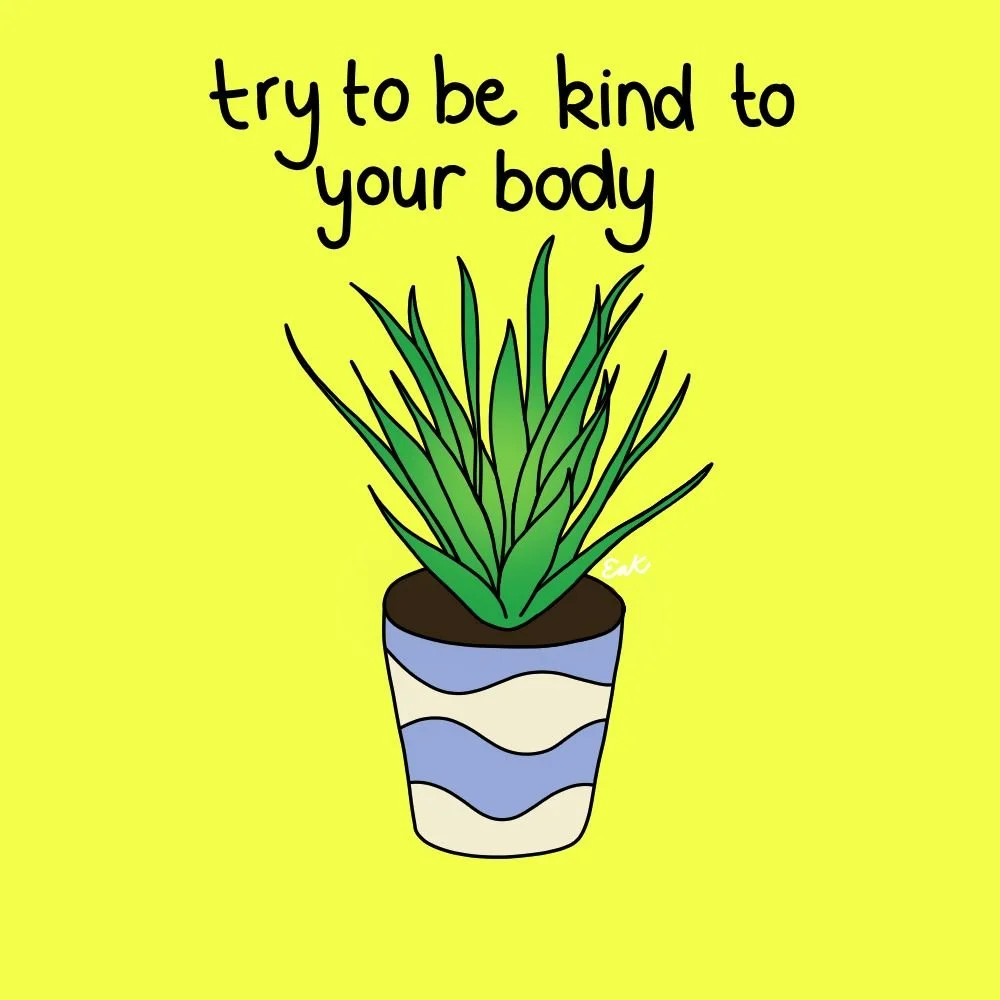
Image by Evie K
The way our peers speak about themselves also makes an impact, albeit not as noticeable. Sometimes, our friends may make comments about their own body, saying that they’ve gained weight, or that their belly is sticking out of their shirt, they don’t have a thigh gap, etc. While these comments towards themselves don’t have the intention of making us feel self-conscious, it can make us feel self-conscious and think: should we be losing weight too?
Our peers’ internalised weight stigma eventually begins to reflect in our own minds. Fatphobia creates negative connotations with bigger bodies, replicating our views of other people and of ourselves.
The way we talk about bodies skews how we see our own. Negative comments are contagious, and the more we hear them, the more we believe in them. It becomes a self-fulfilling prophecy: we criticise ourselves, feel worse about it, and develop unrealistic habits to mold ourselves into the impossible ideal. To break this cycle, we need to change the language we use and the way we approach these conversations.
How we can talk to each other about diets?
We can’t change societal ideologies overnight, but we can start by being kind to ourselves and others with small habits.
1. Don’t comment negatively on bodies (or at all)
A great way to start is to stop commenting on your own or each other’s bodies in a negative light. This reduces a person to just their appearance and reinforces the idea that one’s value is simply tied to their looks. Instead, when greeting someone, you can start off with a compliment that is unrelated to their physical appearance, such as “I love your outfit!” or “I love how full of energy you are today!”. This empowers yourself and others to treat people with kindness. A general rule of thumb that I like is - don’t make a comment on things that can’t be fixed within three minutes. For example, if you can see someone’s clothing tag, or their makeup is smudged, a gentle comment will help them fix the issue.
2. Speak neutrally about food
It’s also important to keep foods neutral, and not glorify nor demonise them. Moral framing of foods can lead to a poor or unrealistic relationship with food, and this habit doesn’t acknowledge that all foods can fit into a balanced lifestyle. For example, after having a meal with friends, avoid saying things like “I’m gonna be good today and not get dessert after this.” Instead, follow your body and eat what you want, when you feel like it. If you’re too full, something like “I’m quite full and don’t want dessert right now. Maybe later”. Or “I can come with you if you want some now!”. It’s also super important not to comment on other people’s choices, as this would be disrespecting someone’s autonomy and doesn’t make anyone feel better afterwards. Parents, carers and teachers should also be aware of the way they talk about foods to themselves and to children, as this could subliminally map the way a child thinks about certain foods. A study showed that the way a parent speaks about diets and eating habits have an indirect effect on their child’s mindset (Jordan, 2025). If you associate specific foods with good or bad habits, a child may grow up thinking the same too!
3. Body liberation
Body positivity has been talked about a lot, but have you heard of body liberation? The body liberation movement is a radical concept that we should live in our bodies without fear of marginalisation or discrimination, and that we should value ourselves by our traits, and not just our bodies. Body liberation aims to break down systemic oppression in a society that excludes bodies that are different. No one should ever have to change or shrink themselves in order to live the life they want to, and we should be able to live loudly and passionately. Body liberation frees us from societal judgment and expectations.
One way to think about ourselves is appreciating our bodies for what it does, and not what we look like. I’ve recently started going to the gym more often because I wanted to feel stronger within my own body. Instead of looking at someone and making a judgment about their looks, what about their personality or energy? The shift in mindset allows us all to live a judgment free lifestyle, which in itself, is liberating! Body liberation can be used as a bridge to broaden social change: challenging ideas driven by misogyny, ableism and racism, that dictate who is valued and who isn’t. Liberation isn’t just about how we feel, but also how we are treated by others.
Conclusion
There is no universal rule of thumb that any food is “good” or “bad”. The reality is much more nuanced than that. For most people, enjoying everything in moderation would be the most balanced approach. But everyone’s relationship to food is different. For those with a history of disordered eating, labelling foods with non-neutral terms may be triggering. Others may have medical conditions or allergies that don’t allow them to have certain foods, because it doesn’t work well for their body.
The importance lies in the trust within your own body: you’re the expert of your own body. What works for you, may not work for others and it's important to respect that boundary. We also need to dismantle the cycle of characterising foods just by its nutritional information. Food is also the medium we use for culture, connection and pleasure. When we stop reducing foods to the information on the label, it frees us to enjoy foods and love our bodies without pressure. We speak as though our minds and bodies are separate, but a healthy mind is a healthy body. When we accept ourselves as we are and stop tearing ourselves down for others, there will be space for us to grow.
We should give ourselves the kindness and grace that a world of judgment may not. Listen to your own body and remember that your worth isn’t defined by what you eat, or how you look. Food, at the end of the day, is made to be enjoyed, not something to be earned. Eat what makes you happy, and let others do the same.
Happy eating everyone!
Reference list
Dennett, C. and Dennett, C. (2026). What is body liberation? Moving past mainstream body positivity | Nutrition By Carrie. [online] Nutrition By Carrie. Available at: https://nutritionbycarrie.com/2026/06/body-liberation-vs-body-positivity.html [Accessed 26 Jun. 2026].
Fitterman-Harris, H.F., Davis, G.G., Bedard, S.P., Cusack, C.E. and Levinson, C.A. (2024). Digital Mental Health Interventions: Differences in Diet Culture Intervention Framing. International Journal of Environmental Research and Public Health, [online] 21(1), p.24. doi:https://doi.org/10.3390/ijerph21010024.
Fiuza, A. and Rodgers, R.F. (2023). The effects of brief diet and anti-diet social media videos on body image and eating concerns among young women. Eating Behaviors, 51, pp.101811–101811. doi:https://doi.org/10.1016/j.eatbeh.2023.101811.
Hogan, L., Johnson, K.J. and Faw, M.H. (2025). Diet Culture Beliefs, Co-Rumination, Intuitive Eating, and Experiences of Internalized Weight Stigma in the Adjustment to College Among Emerging Adult Women. Emerging Adulthood. doi:https://doi.org/10.1177/21676968251338573.
Jordan, E. (2025). Diet culture socialization in the parent-child relationship: Effects on children’s disordered eating and positive body image. Journal of Social and Personal Relationships. doi:https://doi.org/10.1177/02654075251328485.
Kwan, M.Y., Gioia, A.N., Braverman, R. and Drumheller, K. (2025). Fitspiration and Thinspiration on Twitter: A Content Analysis. European Eating Disorders Review. doi:https://doi.org/10.1002/erv.3190.
Munro, E., Wells, G., Paciente, R., Wickens, N., Ta, D., Mandzufas, J., Lombardi, K. and Woolard, A. (2024). Diet culture on TikTok: a descriptive content analysis. Public Health Nutrition, 27(1). doi:https://doi.org/10.1017/s1368980024001381.
Speak to one of our unembarrassable team members to find out how we can support your school with workshops on body image and nutrition.